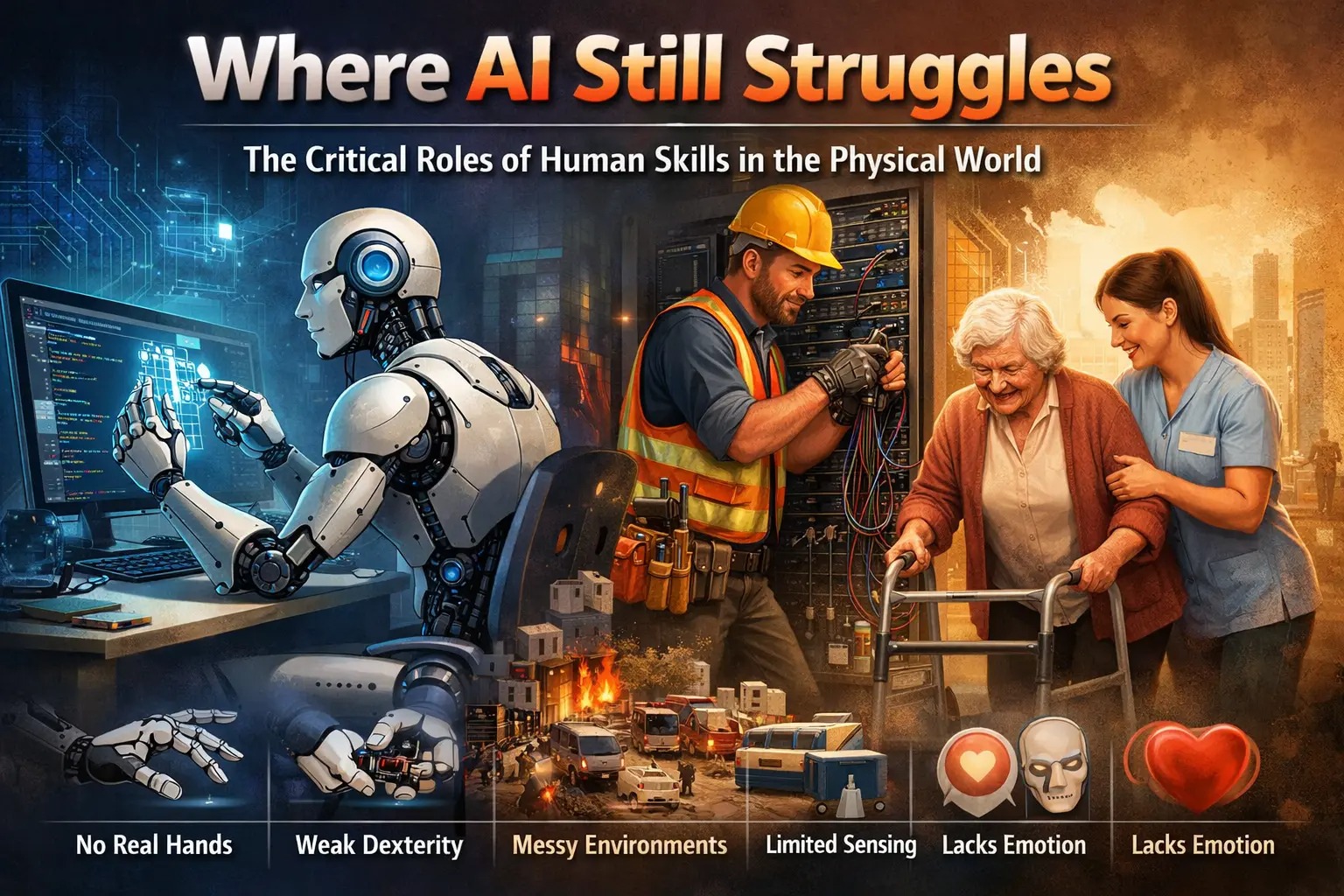
Artificial intelligence has made remarkable progress in recent years. AI systems can generate text and images, analyze large datasets, assist with software development, summarize documents, support customer service, and automate selected digital workflows.
Yet strong performance in the digital world does not automatically translate into equal capability in the physical world.
Real environments are messy, unpredictable, and constantly changing. A task that seems simple to a person—handling a fragile object, repairing equipment in a cramped space, helping someone maintain balance, or adapting when conditions suddenly change—can be extremely difficult to automate reliably.
This gap matters for businesses, workers, educators, and technology professionals. As AI changes digital work, many human capabilities remain especially important where physical interaction, situational awareness, practical judgment, adaptability, and interpersonal trust are required.
This article explores where AI still struggles in the physical world, why robotics does not automatically solve every limitation, and which human skills may become even more valuable as intelligent systems continue to improve.
🤖 AI Intelligence Is Not the Same as Physical Capability
One of the most important distinctions in discussions about AI is the difference between processing information and acting reliably in the physical world.
A software-based AI system may be able to:
- Explain how a device works
- Analyze a technical manual
- Suggest troubleshooting steps
- Generate code
- Classify images
- Summarize maintenance records
- Recommend possible actions
But knowing what should be done is different from physically performing the task.
For example, an AI system might explain how to upgrade a computer, but the physical work may still involve:
- Opening the case safely
- Identifying the correct component
- Managing static electricity risks
- Applying the right amount of force
- Working around cables and nearby parts
- Recognizing an unexpected hardware configuration
- Stopping when something does not feel right
This difference between digital reasoning and physical execution is one of the central challenges facing robotics and embodied AI.
🦾 1. AI Usually Does Not Have a General-Purpose Human Body
Most AI systems people use today operate primarily through software interfaces. They process text, images, audio, code, or structured data, but they do not independently manipulate the physical environment.
Connecting AI to a robot changes what the system can potentially do, but it also introduces a much harder engineering problem.
A physical machine may need:
- Cameras and other sensors
- Robotic arms or mobile components
- Reliable perception
- Precise control
- Safe movement planning
- Real-time decision-making
- Power management
- Error recovery
- Human safety systems
The physical world creates constraints that do not exist in a text conversation or software application.
A wrong sentence from a chatbot may be corrected. A wrong movement by a machine near a person, vehicle, expensive device, or fragile object can have immediate physical consequences.
This is one reason physical automation requires careful engineering, testing, and safety controls.
✋ 2. Fine Dexterity Remains a Difficult Challenge
Human hands are extraordinarily capable. People can grasp objects of different shapes, adjust pressure almost instantly, reposition their fingers, feel resistance, and coordinate vision with movement.
Many of these abilities happen without conscious calculation.
Consider the difference between repeatedly moving identical objects on a production line and repairing an unfamiliar electronic device.
A repair technician may need to:
- Handle tiny screws
- Disconnect delicate cables
- Avoid damaging nearby components
- Work around unexpected modifications
- Notice signs of heat or physical damage
- Adjust grip and pressure continuously
- Use different tools in a confined space
These tasks combine perception, touch, experience, and continuous adaptation.
Robots can achieve impressive precision in suitable environments, especially when tasks, objects, and conditions are carefully designed. The harder challenge is achieving similar reliability across varied, unfamiliar, and unpredictable situations.
🔧 3. Real-World Objects Are Not Standardized
Digital information can often be transformed into structured formats. Physical objects are less cooperative.
Two homes may have completely different layouts. Two damaged devices may fail in different ways. Two construction sites may present different obstacles. Even products of the same model may differ because of wear, previous repairs, dirt, damage, or user modifications.
A human worker can often inspect a situation and improvise.
For example, a technician may discover that:
- A screw is stripped
- A connector is damaged
- A replacement part does not fit correctly
- A cable has been routed unexpectedly
- Documentation does not match the actual installation
- Previous repair work changed the original configuration
These exceptions are common in real life.
Automation becomes more difficult when the system must handle not only the expected process but also the long tail of unusual conditions.
🌍 4. AI Struggles More in Messy and Changing Environments
AI and robotic systems often perform best when the environment is sufficiently structured, observable, and predictable.
The physical world is frequently the opposite.
A home may contain:
- Furniture in unexpected locations
- Pets moving unpredictably
- Children
- Reflective surfaces
- Poor lighting
- Narrow passages
- Objects left on the floor
A construction site may change throughout the day. A disaster area may contain unstable structures. A crowded market may involve people moving in ways that are difficult to predict.
Humans are remarkably good at adapting to such conditions.
We continuously combine:
- Vision
- Hearing
- Balance
- Memory
- Context
- Social awareness
- Experience
- Practical judgment
A machine may perform well in one tested environment yet encounter difficulty when lighting, object placement, terrain, visibility, or human behavior changes.
🧠 5. Common Sense Is Broader Than Pattern Recognition
AI systems can identify complex patterns, but real-world common sense involves a wide range of contextual knowledge.
Imagine carrying a box through a crowded office.
A person may automatically understand that:
- The floor is wet
- Someone may open a nearby door
- A child could move unexpectedly
- The box blocks part of the view
- A fragile object inside may shift
- Another person appears distracted
- The safest route is not necessarily the shortest route
Humans often combine many small signals without explicitly listing them.
For AI and robotics, this kind of open-ended reasoning is difficult because the number of possible situations is enormous.
The challenge is not simply recognizing an object. It is understanding what matters right now, what could happen next, and how to act safely under uncertainty.
🖐️ 6. Touch and Force Control Are Hard to Replicate
Touch provides humans with continuous information about the physical world.
Without looking directly, a person can often sense whether:
- An object is slipping
- A surface is rough
- A component is resisting movement
- A material is flexible
- A grip is too strong
- Something is unstable
Machines can use force sensors, tactile sensors, cameras, and other technologies to gather physical information. These systems are improving, but integrating sensory input into reliable, general-purpose action remains challenging.
This matters in tasks such as:
- Handling fragile products
- Repairing electronics
- Assisting a person with movement
- Sorting irregular objects
- Working with soft materials
- Manipulating unfamiliar tools
The difficulty is not only sensing force. The system must interpret the situation and respond appropriately.
⚡ 7. Humans Adapt Quickly When Something Goes Wrong
Many physical tasks do not proceed exactly as planned.
A technician may hear an unusual sound. A nurse may notice a patient becoming uncomfortable. An electrician may find that an installation differs from the diagram. A field engineer may discover damage that was not reported.
Humans can often stop, reassess, ask questions, change tools, or create a new approach.
This ability is especially important when:
- Information is incomplete
- The environment changes
- Equipment behaves unexpectedly
- Safety is uncertain
- Multiple problems occur together
AI systems can support diagnosis and decision-making, but open-ended adaptation in unfamiliar physical situations remains difficult.
❤️ 8. Emotional Presence Matters in Human-Centered Physical Roles
Some roles require more than completing a technical task. They involve trust, reassurance, motivation, dignity, and interpersonal understanding.
Consider a caregiver helping an older person move safely.
The task may involve noticing:
- Fear
- Hesitation
- Pain
- Confusion
- Embarrassment
- Fatigue
- A subtle change in behavior
A technically correct movement may still be inappropriate if the person feels unsafe or distressed.
Similar human factors matter in:
- Nursing
- Teaching
- Physical rehabilitation
- Childcare
- Coaching
- Emergency response
- Customer-facing field services
AI can support professionals with information and selected forms of assistance. That does not mean every part of the human relationship can or should be automated.
👀 9. Human Perception Combines More Than Cameras and Sensors
Machines can use cameras, microphones, depth sensors, force sensors, and other technologies. In selected tasks, they may detect patterns that humans miss.
However, human perception is deeply connected to context and experience.
An experienced technician may notice:
- A faint burning smell
- An unusual vibration
- A slightly loose connection
- A sound that indicates mechanical wear
- A visual pattern associated with previous failures
The observation may be difficult to describe formally, yet it can guide investigation.
This is one reason practical experience remains valuable. Skilled people often build mental models from years of interacting with real systems.
🏭 Where AI and Robotics Already Perform Well
A balanced discussion should also recognize that physical AI and robotics are already highly capable in many areas.
Automation can perform extremely well when:
- Tasks are repetitive
- Objects are standardized
- The environment is controlled
- Success conditions are measurable
- Safety boundaries are clearly defined
Examples may include:
- Industrial assembly
- Automated inspection
- Warehouse movement
- Precision manufacturing
- Selected agricultural operations
- Laboratory automation
- Machine-assisted surgery
- Infrastructure inspection
The important lesson is not that robots are incapable. It is that capability depends heavily on the task, environment, acceptable error rate, and system design.
🚧 Why “Just Add AI” Does Not Solve Physical Automation
Businesses sometimes assume that adding a powerful AI model to a robot will automatically create human-like physical intelligence.
In practice, a complete system may need to solve multiple problems:
- Perception
- Localization
- Movement
- Object manipulation
- Planning
- Communication
- Safety
- Error recovery
- Maintenance
- Cybersecurity
A failure in any one layer can affect the whole system.
For example, a robot may correctly identify an object but still fail to grasp it. It may grasp the object but choose an unsafe route. It may navigate successfully but fail when a person behaves unexpectedly.
Physical intelligence is therefore a systems engineering challenge, not simply a matter of connecting a language model to a machine.
👷 What These AI Limitations Mean for Careers
As AI automates selected digital tasks, careers that combine technical knowledge with physical capability, practical judgment, or strong interpersonal skills may remain especially important.
This does not mean such careers will never change. Many will use more AI-powered tools. The difference is that AI may support the worker rather than fully remove the need for a skilled person.
Examples include:
IT Support Technician
IT support professionals work with real devices, users, networks, operating systems, peripherals, and unexpected failures.
AI can suggest troubleshooting steps, but a technician may still need to inspect equipment, identify unusual configurations, replace components, and communicate with frustrated users.
Network and Infrastructure Technician
Physical network work can involve:
- Installing equipment
- Managing cables
- Diagnosing connectivity problems
- Working in server rooms
- Inspecting physical infrastructure
- Responding to unexpected failures
AI can assist with monitoring and analysis, while technicians handle real-world installation and intervention.
Robotics Technician
As organizations deploy more automated systems, people are needed to install, calibrate, inspect, troubleshoot, and maintain them.
The growth of robotics can therefore create demand for human expertise around the machines themselves.
Field Service Engineer
Field engineers work in environments that may differ from documentation or expectations.
They often combine:
- Technical knowledge
- Physical inspection
- Customer communication
- Troubleshooting
- Safety judgment
- Improvisation
These are difficult capabilities to automate as a complete package.
Healthcare Technology Specialist
Modern healthcare depends on increasingly complex equipment and digital systems.
Professionals may need to understand both technology and the practical realities of clinical environments, where reliability, privacy, safety, and communication are critical.
Electrician and Automation Specialist
Electrical and automation work requires physical installation, inspection, diagnosis, standards awareness, and safety judgment.
AI may support planning or fault analysis, but real-world execution remains highly dependent on trained professionals.
Skilled Repair Technician
Repair work often involves damaged, worn, modified, or poorly documented equipment.
The technician must frequently discover the real problem rather than follow a perfectly defined sequence.
📚 Human Skills That May Become More Valuable
The rise of AI does not mean people should ignore technology. A stronger strategy is to combine technical literacy with capabilities that are difficult to automate completely.
Practical Problem-Solving
Learn how to diagnose problems when information is incomplete and the first solution does not work.
Technical Literacy
Understand software, networks, data, AI tools, automation, and digital systems even if your role includes physical work.
Communication
The ability to explain problems, understand requirements, manage expectations, and work with different people remains valuable.
Adaptability
Tools and job requirements will continue to change. People who can learn new systems and adjust their methods are better positioned for changing work environments.
Safety Judgment
Physical work often involves risks that require context, caution, and accountability.
Domain Expertise
Deep knowledge of a specific industry can become more valuable when combined with AI tools.
Human Collaboration
Many important projects require negotiation, trust, teamwork, leadership, and shared responsibility.
🤝 The Strongest Future May Be Human + AI
The future of work is unlikely to be explained by a simple choice between humans and machines.
In many situations, the stronger model may be human capability combined with AI assistance.
For example:
- A technician uses AI to analyze equipment logs before performing a physical inspection.
- A doctor uses AI-assisted analysis while retaining responsibility for clinical decisions.
- A field engineer uses predictive maintenance data to prioritize site visits.
- A warehouse worker uses intelligent systems to locate inventory more efficiently.
- A developer uses AI assistance while reviewing architecture, security, and production code.
- A teacher uses AI-generated materials while adapting lessons to actual students.
In these examples, AI contributes speed, analysis, or information processing. Humans contribute context, accountability, physical capability, and judgment.
🔮 Will AI Eventually Overcome These Limitations?
AI and robotics will continue to improve. It would be unwise to assume that today's limitations will remain unchanged forever.
Progress in areas such as the following may expand physical AI capabilities:
- Robotics foundation models
- Better tactile sensing
- Computer vision
- Reinforcement learning
- Improved robotic hands
- Simulation
- Edge AI
- Multimodal models
- Autonomous navigation
However, technical progress does not automatically mean universal deployment.
Real-world adoption also depends on:
- Cost
- Reliability
- Energy requirements
- Maintenance
- Safety
- Regulation
- Insurance
- Public acceptance
- Integration with existing infrastructure
The question is therefore not only “Can a machine perform this task?”
Businesses must also ask:
“Can it perform the task reliably, safely, economically, and consistently in the real environment where it will be used?”
🎯 How Workers Can Prepare for an AI-Driven Future
People do not need to compete with AI at every task. A better strategy is to understand where technology is strong, where humans remain valuable, and how the two can work together.
Consider developing a combination of:
- AI literacy
- Digital skills
- Practical technical ability
- Communication
- Problem-solving
- Industry knowledge
- Physical expertise
- Adaptability
For example, a networking professional who understands AI-assisted monitoring may be more valuable than someone who ignores new technology.
A repair technician who uses digital diagnostics effectively may work faster than one who relies only on traditional methods.
A software developer who understands AI tools while maintaining strong architecture, security, and validation skills can use automation without depending on it blindly.
The goal is not to avoid AI. The goal is to build capabilities that become stronger when AI is used intelligently.
🏁 Final Thoughts
Artificial intelligence is powerful, but intelligence in a digital environment is not the same as reliable capability in the physical world.
AI can analyze information, generate content, assist with code, identify patterns, and support decisions. Yet real-world tasks often require a complex combination of dexterity, touch, perception, adaptation, common sense, safety awareness, and human connection.
Robotics will continue to improve, and some physical tasks will become increasingly automated. At the same time, human skills will remain important wherever environments are unpredictable, consequences are significant, and people must respond to situations that were not fully anticipated.
The future is not simply about AI replacing humans.
A more useful question is:
How can people combine AI capabilities with uniquely human strengths to solve real problems better?
For workers, businesses, and technology professionals, that combination may become one of the most valuable skills of the coming years.