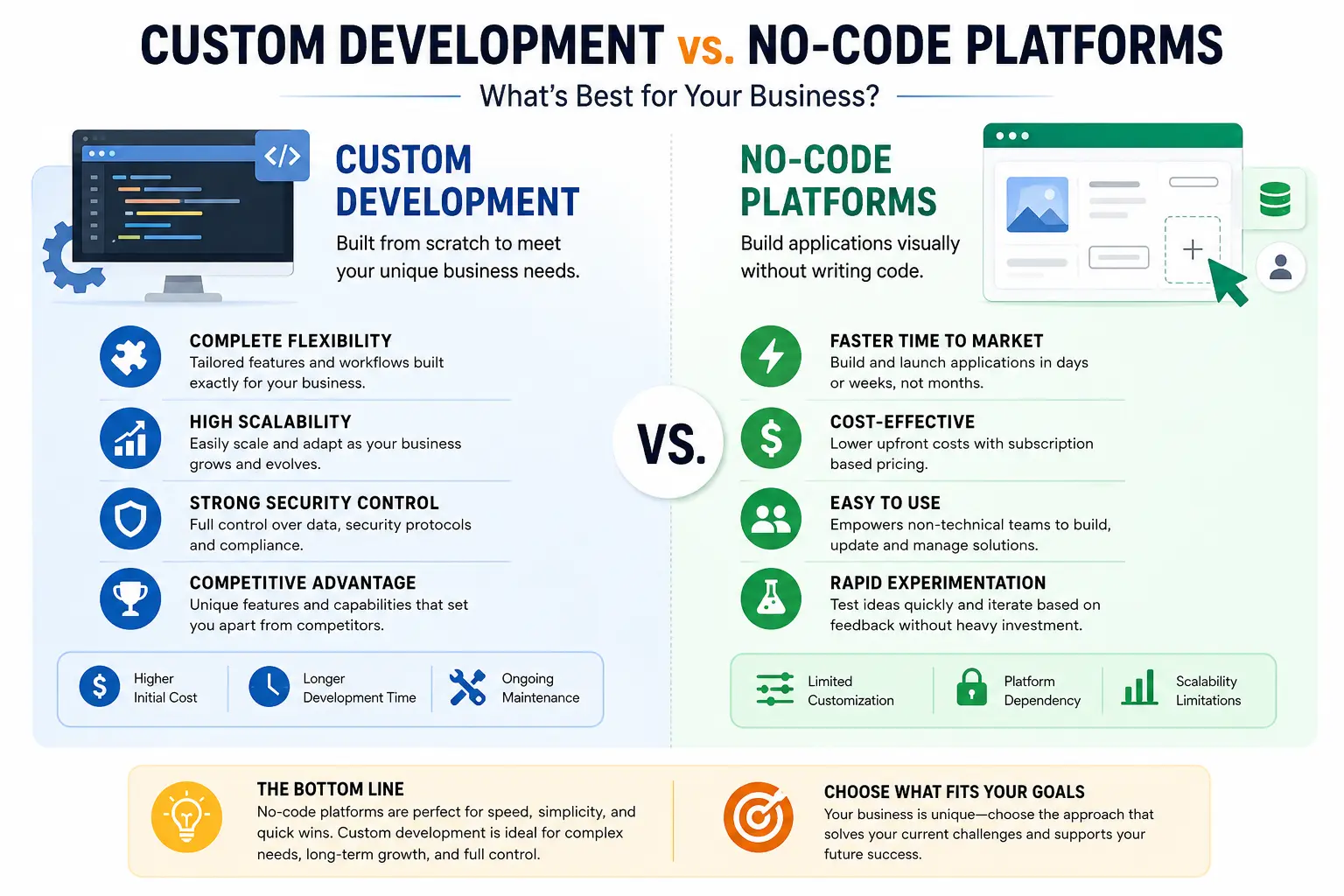
In today's digital-first world, almost every business eventually faces the same question: Should we build custom software from scratch, or should we use a no-code platform to get things done faster?
Whether you're launching a startup, digitizing operations, building a customer portal, creating an internal management system, or automating workflows, choosing the right approach can significantly impact your budget, growth, and long-term success.
The truth is, there is no universal answer.
Both Custom Development and No-Code Platforms have their own strengths and limitations. The best choice depends on your business goals, budget, timeline, technical requirements, and future scalability needs.
Let's objectively compare both approaches so you can make an informed decision.
Understanding Custom Development
Custom development refers to building software specifically designed for your business requirements. A team of developers writes code from scratch or uses programming frameworks to create a tailored solution.
Examples include:
- Customer Relationship Management (CRM) systems
- Enterprise Resource Planning (ERP) software
- Mobile applications
- E-commerce platforms
- Industry-specific management systems
- Internal employee portals
Every feature is designed according to your exact business processes.
Advantages of Custom Development
1. Complete Flexibility
One of the biggest advantages is that your software is built around your business instead of forcing your business to adapt to software limitations.
You can create:
- Unique workflows
- Custom dashboards
- Specialized reporting systems
- Complex integrations
- Industry-specific features
2. Better Scalability
As your company grows, custom software can evolve alongside your business.
You can continuously add:
- New modules
- Additional users
- New business processes
- Advanced automation
Without being restricted by platform limitations.
3. Strong Competitive Advantage
Custom solutions can provide capabilities that competitors may not have.
For example:
- Personalized customer experiences
- Proprietary business processes
- Unique operational efficiencies
These differentiators can become long-term business assets.
4. Greater Control Over Security
Organizations handling sensitive data often prefer custom solutions because they can implement security standards tailored to their requirements.
This is particularly valuable in industries such as:
- Healthcare
- Finance
- Pharmaceuticals
- Legal services
Challenges of Custom Development
Higher Initial Cost
Building software from scratch requires significant investment.
Expenses may include:
- Developers
- Designers
- Project managers
- Infrastructure costs
- Testing resources
Longer Development Time
Projects can take months or even years depending on complexity.
Ongoing Maintenance Responsibility
Software requires continuous:
- Updates
- Bug fixes
- Security patches
- Feature enhancements
Understanding No-Code Platforms
No-code platforms allow users to create applications, websites, databases, and workflows using visual interfaces instead of traditional programming.
Popular use cases include:
- Business dashboards
- Appointment systems
- Customer portals
- Workflow automation
- Internal tools
- Simple mobile applications
Many businesses can launch solutions without hiring a large development team.
Advantages of No-Code Platforms
1. Faster Implementation
Speed is one of the biggest benefits.
Projects that may take several months with traditional development can often be completed within days or weeks.
Businesses can quickly validate ideas and launch products.
2. Lower Cost
No-code platforms dramatically reduce development expenses.
You often pay:
- Monthly subscriptions
- Platform licensing fees
Instead of large upfront development costs.
3. Easier for Non-Technical Teams
Business owners and employees can build and modify solutions themselves.
This reduces dependency on IT departments.
4. Rapid Experimentation
Businesses can test ideas without major financial risk.
This is particularly valuable for:
- Startups
- Small businesses
- Entrepreneurs
Challenges of No-Code Platforms
Limited Customization
Complex requirements may eventually exceed platform capabilities.
Some businesses find themselves constrained as they grow.
Vendor Dependency
Your application is tied to the platform provider.
Changes in:
- Pricing
- Features
- Policies
Can directly impact your business.
Scalability Limitations
Handling large datasets, complex operations, or advanced business logic may become difficult.
Integration Constraints
Although many platforms offer integrations, highly specialized systems may require additional workarounds.
Side-by-Side Comparison
| Factor | Custom Development | No-Code Platforms |
|---|---|---|
| Initial Cost | High | Low |
| Time to Launch | Months | Days or Weeks |
| Flexibility | Very High | Moderate |
| Scalability | Excellent | Good (depends on platform) |
| Technical Expertise Required | High | Low |
| Maintenance | Your responsibility | Managed by platform |
| Security Control | Full control | Shared with provider |
| Long-Term Ownership | Complete ownership | Platform dependent |
| Best For | Complex businesses | Small to medium projects |
Which Businesses Should Choose No-Code?
No-code platforms work extremely well for businesses that need speed and simplicity.
Ideal examples include:
Startups
When validating ideas before investing heavily.
Small Businesses
For digitizing operations without large IT budgets.
Marketing Teams
For creating landing pages, lead management systems, and customer portals.
Internal Business Operations
Such as:
- Employee onboarding
- Inventory tracking
- Approval systems
Which Businesses Should Choose Custom Development?
Custom development becomes valuable when your requirements are unique and long-term.
Ideal scenarios include:
Large Enterprises
Businesses with complex operations across departments.
Highly Regulated Industries
Such as:
- Healthcare
- Banking
- Pharmaceuticals
Businesses with Unique Processes
When standard software cannot accommodate specialized workflows.
Companies Planning Long-Term Digital Transformation
Where technology becomes a core competitive advantage.
Is a Hybrid Approach the Best Option?
In many cases, yes.
Modern businesses increasingly adopt a hybrid strategy.
For example:
Start with No-Code
- Build an MVP (Minimum Viable Product)
- Test market demand
- Gather customer feedback
Move to Custom Development Later
Once the business model is proven and requirements become more sophisticated.
This approach minimizes risk while preserving future flexibility.
Questions Every Business Owner Should Ask Before Deciding
Before making a decision, ask yourself:
- What problem am I trying to solve?
- How quickly do I need the solution?
- What is my available budget?
- Will this system need to scale significantly over time?
- How unique are my business processes?
- How important is full ownership and control?
- Do I have access to technical expertise?
Your answers will often make the decision much clearer.
Final Thoughts
Technology decisions should support business goals, not complicate them.
No-code platforms are excellent for speed, affordability, and rapid innovation.
Custom development excels when businesses need flexibility, scalability, and complete control.
Neither option is inherently better than the other.
The smartest decision is choosing the solution that aligns with your current stage of growth while keeping future expansion in mind.
Sometimes the answer is no-code.
Sometimes it's custom development.
And often, the most practical strategy is using both at different stages of your business journey.
Remember: The goal is not to adopt the most advanced technology. The goal is to adopt the right technology that helps your business grow efficiently and sustainably.
go to www.sarabirsolutions.com for complete details.