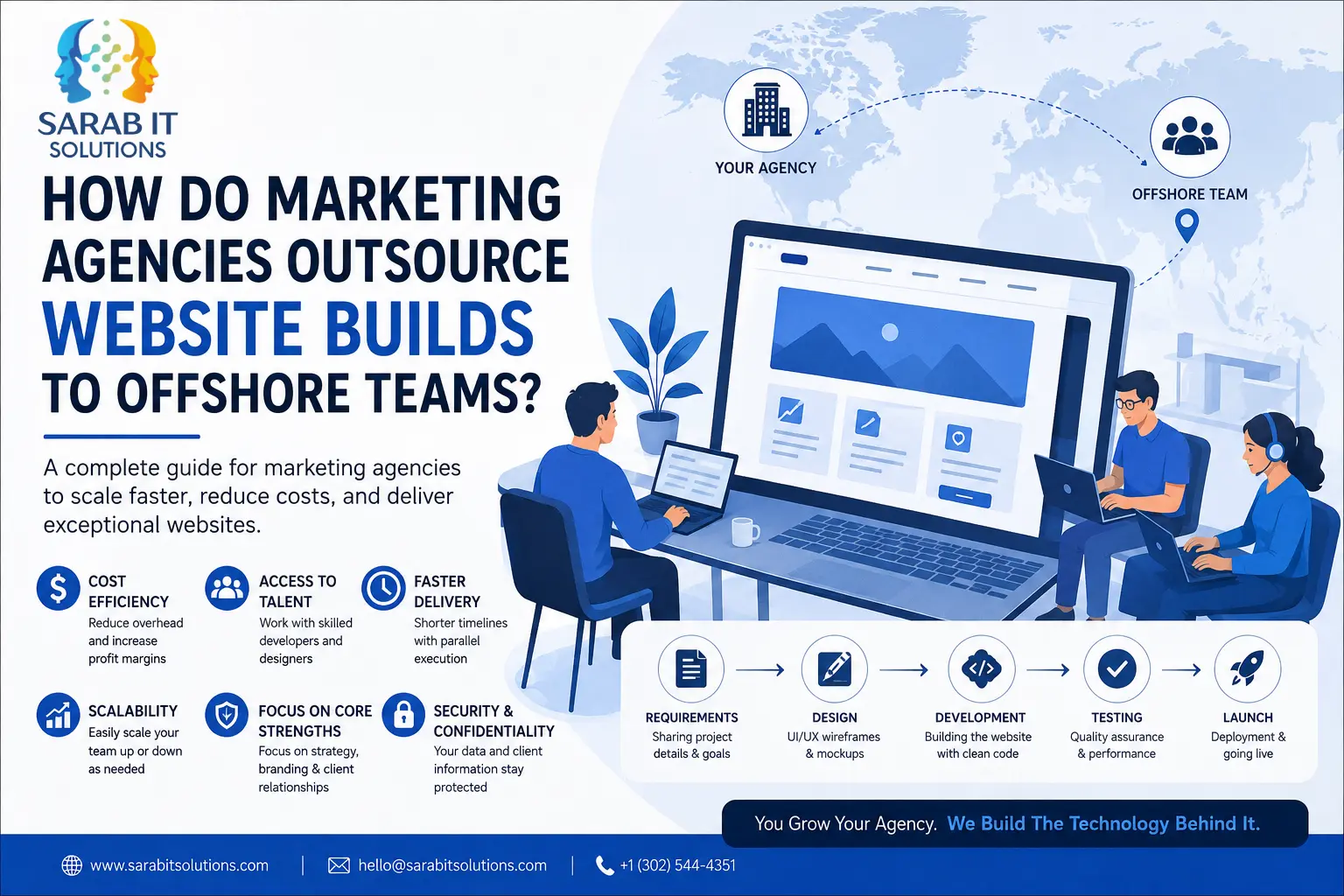
In today's digital economy, marketing agencies are under constant pressure to deliver high-quality websites quickly, cost-effectively, and at scale. Clients expect modern designs, SEO optimization, fast loading speeds, responsive interfaces, and seamless integrations—all while staying within budget.
To meet these growing demands, many marketing agencies have adopted a powerful business model: outsourcing website development to offshore teams.
This approach allows agencies to focus on their core strengths—strategy, branding, advertising, and client relationships—while specialized offshore development teams handle the technical execution.
This guide explains how marketing agencies successfully outsource website builds to offshore teams and how businesses like Sarab IT Solutions can become a trusted offshore technology partner.
What is Offshore Website Development Outsourcing?
Offshore outsourcing is the practice of hiring a website development team located in another country to build websites on behalf of a marketing agency.
Instead of maintaining a large in-house technical team, agencies collaborate with experienced offshore developers who work remotely and deliver projects under the agency's brand.
The client often never interacts directly with the offshore team. The agency remains the primary point of contact while the offshore partner works in the background.
Common Website Projects Agencies Outsource
Marketing agencies typically outsource:
- Corporate websites
- Business websites
- E-commerce stores
- Landing pages
- WordPress websites
- Shopify stores
- Custom web applications
- Customer portals
- Membership websites
- Blog platforms
- Website redesign projects
- SEO technical optimization
Why Marketing Agencies Choose Offshore Teams
1. Cost Efficiency
Hiring a full in-house team can be expensive.
A typical website project may require:
- UI/UX Designer
- Front-end Developer
- Back-end Developer
- WordPress Developer
- QA Tester
- SEO Specialist
- Project Manager
Maintaining all these resources internally significantly increases operating costs.
Offshore teams provide access to the same expertise at a lower operational expense.
Agency Benefits:
- Lower payroll costs
- Reduced office expenses
- No recruitment overhead
- Flexible resource allocation
- Improved profit margins
2. Access to Specialized Talent
Modern websites require diverse technical expertise.
Offshore teams often provide specialists in:
Front-end Technologies
- HTML5
- CSS3
- JavaScript
- React
- Next.js
- Vue.js
Back-end Technologies
- PHP
- Laravel
- Node.js
- Python
- Django
CMS Platforms
- WordPress
- Shopify
- Webflow
- WooCommerce
Cloud Technologies
- AWS
- DigitalOcean
- Google Cloud
Marketing agencies gain instant access to these skills without lengthy hiring processes.
3. Faster Project Delivery
Time is critical in agency operations.
An offshore team enables parallel execution.
Example Workflow:
Agency Team:
- Client meetings
- Strategy planning
- Branding
- Content creation
- SEO planning
Offshore Team:
- Wireframing
- UI development
- Backend coding
- Testing
- Deployment
This division dramatically shortens project timelines.
Typical Offshore Website Outsourcing Workflow
Step 1: Agency Acquires Client
The agency signs a contract with the client.
The client requirements include:
- Business objectives
- Brand guidelines
- Features required
- Timeline
- Budget
Step 2: Agency Creates Project Documentation
The agency prepares:
Project Brief
Contains:
- Company overview
- Website goals
- Competitor references
- Target audience
Technical Requirements
Includes:
- Number of pages
- Forms required
- Integrations
- CMS preference
- SEO requirements
Step 3: Offshore Team Reviews Requirements
The offshore partner analyzes:
- Scope complexity
- Development timeline
- Resource requirements
- Technology stack
- Potential risks
They then provide:
- Effort estimation
- Development roadmap
- Milestone schedule
Step 4: UI/UX Design Phase
Designers create:
- Wireframes
- Homepage concepts
- Inner pages
- Mobile designs
Tools used:
- Figma
- Adobe XD
The agency reviews and approves before development begins.
Step 5: Development Phase
The offshore team starts building the website.
Tasks include:
Front-End Development
Building:
- Responsive layouts
- Interactive elements
- Animations
- User interfaces
Back-End Development
Creating:
- Databases
- User management
- APIs
- Integrations
Step 6: Quality Assurance
Testing covers:
Functional Testing
- Contact forms
- Menus
- User journeys
Browser Testing
- Chrome
- Safari
- Firefox
- Edge
Mobile Testing
- Android
- iPhone
- Tablets
Performance Testing
- Loading speed
- Image optimization
- Core Web Vitals
Step 7: Client Review Process
The agency presents the completed website to the client.
Any feedback is routed through the agency rather than directly to developers.
This maintains agency ownership of the client relationship.
Step 8: Website Launch
Final tasks:
- Domain setup
- Hosting configuration
- SSL installation
- SEO indexing
- Analytics setup
The website goes live.
Popular Offshore Collaboration Models
Dedicated Team Model
Best for large agencies.
The offshore team works exclusively for one agency.
Advantages:
- Consistent quality
- Faster communication
- Long-term relationships
Project-Based Model
Ideal for occasional website projects.
The agency outsources individual projects.
Advantages:
- Flexible
- Budget friendly
- No long-term commitments
White Label Partnership
Most preferred model.
The offshore team works invisibly under the agency's brand.
The client sees only the agency.
Advantages:
- Brand protection
- Scalability
- Confidentiality
Tools Used for Offshore Collaboration
Communication Tools
- Slack
- Microsoft Teams
- Zoom
- Google Meet
Project Management Tools
- Trello
- Asana
- Jira
- ClickUp
Design Tools
- Figma
- Adobe XD
Documentation Tools
- Google Docs
- Notion
Code Management
- GitHub
- GitLab
- Bitbucket
Common Challenges and Their Solutions
Challenge 1: Communication Gaps
Solution
- Daily updates
- Weekly meetings
- Clear documentation
Challenge 2: Time Zone Differences
Solution
- Overlapping work hours
- Scheduled meetings
- Shared calendars
Challenge 3: Quality Concerns
Solution
- Defined SOPs
- QA checklists
- Milestone approvals
Challenge 4: Data Security
Solution
- NDA agreements
- Secure access controls
- Password management systems
- Role-based permissions
Best Practices for Successful Offshore Partnerships
Marketing agencies should:
Create Standard Operating Procedures (SOPs)
Document:
- Design guidelines
- Coding standards
- SEO requirements
- Approval processes
Use Milestone-Based Delivery
Break projects into:
- Discovery
- Design
- Development
- Testing
- Launch
Maintain Transparent Communication
Establish:
- Weekly status reports
- Project dashboards
- Escalation channels
How Sarab IT Solutions Can Help Marketing Agencies
Sarab IT Solutions can serve as a trusted offshore white-label development partner for global marketing agencies.
Services Offered:
Website Development
- Corporate websites
- Business websites
- WordPress development
- Custom web applications
- Landing pages
E-commerce Development
- Shopify stores
- WooCommerce stores
- Product catalog systems
Technical Services
- Website maintenance
- Speed optimization
- SEO implementation
- Security updates
White Label Support
- Confidential delivery
- NDA protection
- Agency branding support
- Dedicated development teams
Future of Offshore Website Outsourcing
The demand for offshore website development will continue to grow due to:
- Rising digital transformation
- Increased demand for websites
- AI-powered development tools
- Global remote work adoption
- Need for cost optimization
Agencies that build strong offshore partnerships can scale faster and become more competitive.
Conclusion
Outsourcing website development to offshore teams is no longer simply a cost-saving strategy; it is a growth strategy.
Marketing agencies can focus on what they do best—winning clients, building brands, and creating marketing campaigns—while trusted offshore partners deliver high-quality technical execution behind the scenes.
When executed correctly, offshore outsourcing creates a win-win relationship that benefits agencies, developers, and clients alike.
Sarab IT Solutions aims to become a reliable technology partner for agencies worldwide by delivering scalable, secure, and high-quality website development services under a white-label partnership model.
"You grow your agency. We build the technology behind it." – Sarab IT Solutions