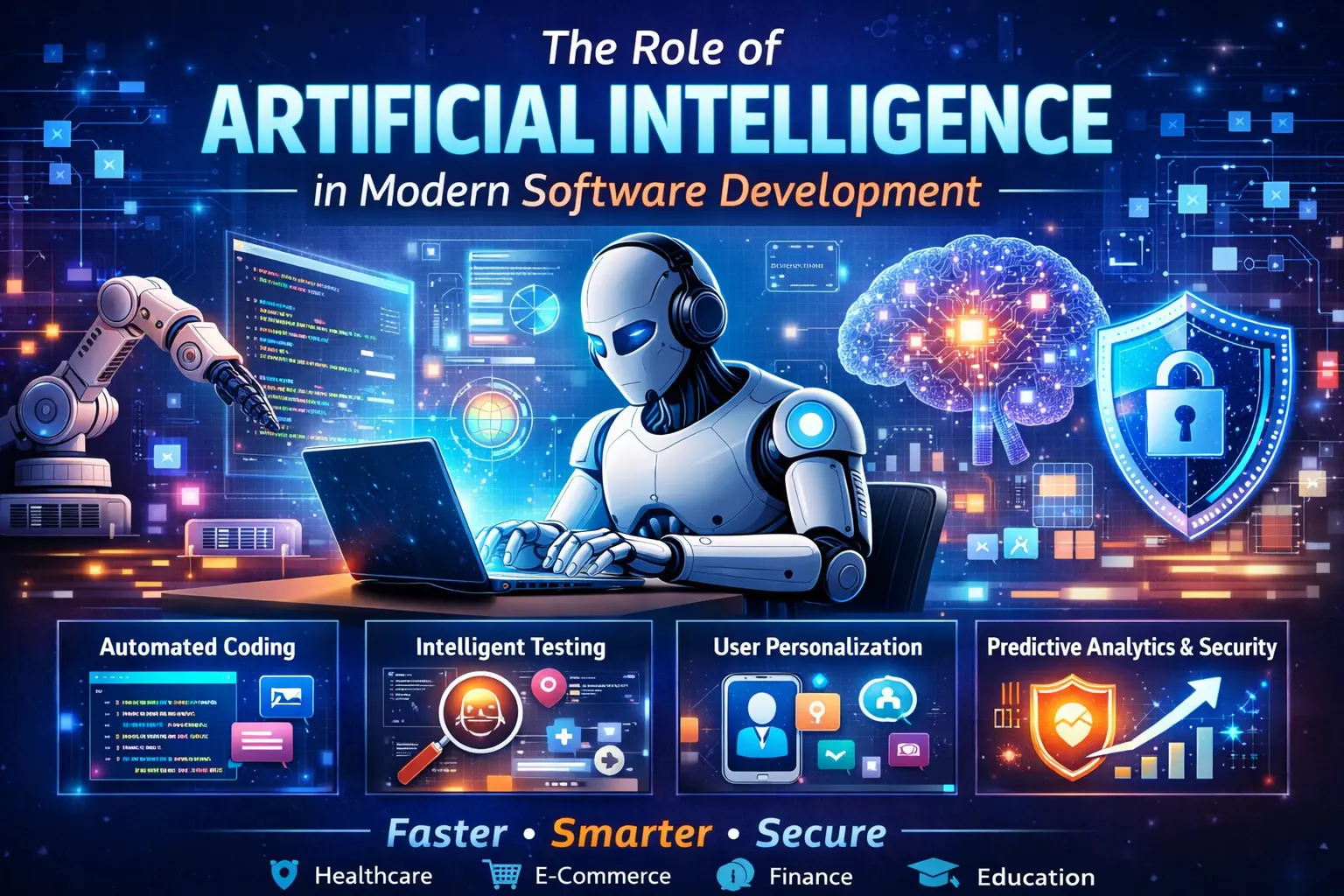
Artificial intelligence is changing how software teams plan, build, test, secure, and improve digital products. What was once considered an experimental technology is now being integrated into developer tools, business applications, customer support systems, analytics platforms, and workflow automation.
For businesses, the importance of AI goes far beyond generating text or using chatbots. Modern AI systems can help analyze data, identify patterns, support decisions, automate repetitive processes, and create more adaptive digital experiences.
At the same time, successful AI adoption requires realistic planning. AI is not a replacement for sound software architecture, experienced developers, secure data practices, or human judgment. Its greatest value often comes from combining intelligent capabilities with well-designed software and clearly defined business requirements.
This guide explores how AI is transforming modern software development, where it can create practical value, what challenges businesses should consider, and how organizations can prepare for AI-enabled software projects.
🚀 What Is Artificial Intelligence in Software Development?
Artificial intelligence in software development generally refers to two related areas. First, developers can use AI-assisted tools throughout the software development lifecycle. Second, development teams can integrate AI-powered capabilities directly into applications, websites, and business systems.
Depending on the project, commonly used AI technologies may include:
- Machine Learning (ML): Systems that identify patterns from data and support predictions or classifications.
- Natural Language Processing (NLP): Technology that helps software understand, process, and generate human language.
- Generative AI: Models capable of producing text, code, images, and other outputs from instructions and context.
- Computer Vision: Systems designed to interpret images, video, and other visual information.
- Predictive Analytics: Methods used to estimate possible future outcomes from historical and current data.
- Intelligent Automation: Workflows that combine software rules, business data, and AI-assisted decisions.
The right technology depends on the actual business problem. A customer-support assistant, fraud-detection system, and demand-forecasting application may all use AI, but they require very different data, architecture, testing, and governance approaches.
⚙️ How AI Is Transforming Modern Software Development
AI is influencing multiple stages of software development rather than only the final application. Teams are increasingly exploring AI-assisted workflows across planning, coding, testing, debugging, documentation, maintenance, and analysis.
1. AI-Assisted Coding and Development
AI coding assistants can help developers generate boilerplate code, explain unfamiliar code, suggest implementations, draft tests, and identify possible issues. This can reduce time spent on repetitive tasks and help developers explore potential solutions more quickly.
However, AI-generated code should not be accepted automatically. Developers still need to review:
- Business logic and functional correctness
- Security vulnerabilities
- Performance implications
- Dependencies and compatibility
- Maintainability and coding standards
- Licensing and organizational policies
The practical model is AI-assisted development, not unsupervised development. AI can accelerate parts of the workflow, while experienced developers remain responsible for architecture, validation, security, and production quality.
2. Faster Software Prototyping
Early-stage software projects often require teams to test ideas before investing in full development. AI-assisted tools can help accelerate initial prototypes, interface concepts, sample workflows, documentation, and proof-of-concept features.
This can be useful when a business needs to evaluate questions such as:
- Will users understand the proposed workflow?
- Can an existing process be automated?
- What data is required for the application?
- Should the idea become a custom web application?
- Which features belong in the first release?
A prototype is not the same as production-ready software. Security, scalability, accessibility, data integrity, and maintainability still require deliberate engineering.
3. Intelligent Software Testing and Quality Assurance
Testing is a critical part of software development because even small defects can affect usability, transactions, business operations, or customer trust.
AI-assisted testing can help teams analyze test results, identify unusual behavior, prioritize areas of risk, and generate candidate test scenarios.
Potential applications include:
- Generating test case suggestions
- Analyzing failed tests
- Identifying patterns in recurring defects
- Supporting regression testing
- Detecting unusual application behavior
- Prioritizing high-risk areas for review
Human oversight remains important because a technically successful test does not always prove that software meets real business requirements or delivers a good user experience.
4. AI-Assisted Debugging and Maintenance
Maintaining software can be as challenging as building it. Development teams often work with logs, legacy code, integrations, dependencies, and complex production environments.
AI-assisted tools can help summarize error information, explain code behavior, suggest possible causes, and support investigation. This may reduce the time required to understand an issue, particularly when developers are working with large codebases.
Still, debugging requires context. An AI-generated suggestion may appear technically plausible while being incorrect for the application's architecture or business rules. Recommendations should therefore be tested and reviewed before deployment.
5. Better Developer Documentation and Knowledge Access
Poor documentation can slow development and make software harder to maintain. AI can assist with first drafts of technical explanations, API documentation, code summaries, onboarding material, and internal knowledge resources.
For established teams, AI-powered search can also help people find relevant information across approved documentation and knowledge bases. The quality of the result depends heavily on the accuracy, permissions, and freshness of the underlying information.
🧠 How AI Is Being Added to Modern Software Applications
AI is not only changing how developers work. It is also changing what modern applications can do. Businesses are exploring intelligent features that make software more responsive to users, data, and operational conditions.
Personalized User Experiences
Traditional software often presents the same experience to every user. AI-enabled systems can analyze appropriate signals and adapt recommendations, content, or workflows.
Examples may include:
- Product recommendations in ecommerce
- Personalized content suggestions
- Adaptive onboarding experiences
- Prioritized information in dashboards
- Customer-specific service recommendations
Personalization should be implemented transparently and with appropriate privacy controls. Collecting more user data does not automatically produce a better experience.
Conversational Interfaces and AI Assistants
AI-powered conversational interfaces can help users search information, navigate services, ask questions, or complete selected tasks using natural language.
Business applications may use AI assistants for:
- Customer support
- Internal knowledge retrieval
- Employee assistance
- Product discovery
- Document exploration
- Workflow guidance
A reliable assistant needs more than a chat box. Businesses should consider source quality, permissions, escalation paths, privacy, monitoring, and the possibility of incorrect AI-generated answers.
Predictive Analytics and Decision Support
Predictive systems use available data to estimate likely outcomes or identify patterns that may deserve attention.
Depending on data quality and business context, applications can support:
- Demand forecasting
- Sales trend analysis
- Customer behavior analysis
- Inventory planning
- Operational risk assessment
- Maintenance forecasting
Predictions should support informed decisions rather than be treated as guaranteed outcomes. Historical data can contain gaps, bias, or patterns that no longer reflect current conditions.
Intelligent Workflow Automation
Many businesses still depend on repetitive manual processes involving forms, documents, emails, spreadsheets, and administrative approvals. AI can complement traditional automation when a process involves less structured information.
For example, an AI-enabled workflow might:
- Classify incoming enquiries
- Extract information from documents
- Summarize customer requests
- Route cases to appropriate teams
- Flag unusual transactions for review
- Generate draft responses for human approval
The strongest automation projects usually begin with a clearly understood process. Adding AI to an inefficient workflow can simply automate the wrong process faster.
💡 Key Benefits of AI in Software Development
The business value of AI depends on the use case, implementation quality, available data, and level of oversight. When applied appropriately, several benefits are possible.
✔ Faster Development Workflows
AI-assisted tools can reduce time spent on repetitive coding, documentation, research, and test preparation. This may allow developers to focus more attention on architecture, complex business logic, and user needs.
✔ Improved Operational Efficiency
AI-enabled applications can support repetitive tasks, analyze high volumes of information, and help teams prioritize work. This can be particularly valuable where employees spend significant time processing routine information.
✔ More Responsive Customer Experiences
Intelligent search, recommendations, personalization, and conversational assistance can make digital services easier to use when implemented carefully.
The goal should be to solve genuine user problems rather than add AI simply because it is popular.
✔ Better Use of Business Data
Many organizations collect data but struggle to turn it into useful insights. AI and analytics can help identify patterns, summarize information, and support decisions, provided that the underlying data is relevant and trustworthy.
✔ Scalable Digital Capabilities
Well-designed AI-enabled systems can help businesses process growing volumes of requests, documents, or interactions. Scalability still depends on software architecture, infrastructure, model costs, and operational controls.
🌍 Real-World Applications of AI Software
AI applications vary widely across industries. The following examples illustrate where intelligent software can create practical value.
Healthcare
AI can support selected areas such as medical image analysis, administrative workflows, research, and clinical decision support.
Healthcare applications require particularly strong attention to accuracy, privacy, regulation, and professional oversight.
Ecommerce and Retail
Online businesses may use AI for:
- Product recommendations
- Customer support
- Demand forecasting
- Search improvement
- Merchandising insights
- Personalized shopping experiences
AI can help ecommerce businesses improve product discovery and customer interactions when it is integrated with a reliable digital platform.
Finance
Financial organizations can use AI for:
- Fraud detection
- Document processing
- Risk analysis
- Customer service
- Transaction monitoring
High-impact financial decisions require careful governance, testing, security, and compliance controls.
Education
AI-enabled educational software can support personalized learning, content discovery, administrative workflows, and tutoring assistance.
Developers should consider accuracy, age-appropriate design, privacy, and the continuing role of educators in the learning process.
Business Operations
Businesses can integrate AI into:
- Internal dashboards
- CRM workflows
- Document processing
- Reporting systems
- Customer support platforms
- Custom business applications
For organizations with requirements that standard software cannot address, purpose-built applications can combine business workflows with carefully selected AI capabilities.
🔐 AI and Software Security
Security is one of the most important considerations in modern software development. AI can support cybersecurity teams by helping analyze large volumes of activity and identify patterns that may require investigation.
Potential applications include:
- Detecting unusual account activity
- Identifying suspicious behavioral patterns
- Supporting threat analysis
- Prioritizing security alerts
- Analyzing logs
- Assisting incident investigation
However, AI should not be treated as an automatic security solution. AI systems themselves can introduce new risks if data, permissions, integrations, and outputs are not properly controlled.
A strong security strategy still requires secure software architecture, access controls, monitoring, testing, updates, and experienced human oversight.
⚠️ Challenges and Risks of AI in Software Development
AI creates significant opportunities, but responsible planning requires an understanding of its limitations. Businesses should evaluate risks before integrating AI into important workflows.
Data Privacy and Security
AI systems may process customer, employee, or business information. Organizations need to understand:
- What data is collected
- Where information is processed
- How long data is retained
- Who can access it
- Whether third-party services are involved
Sensitive information should not be sent to external AI services without appropriate review, safeguards, and authorization.
Incorrect or Fabricated Outputs
Generative AI systems can produce confident responses that are incomplete, misleading, or incorrect.
This is particularly important in high-impact contexts involving:
- Finance
- Healthcare
- Legal matters
- Security
- Critical business operations
Applications should use suitable validation, source grounding, monitoring, and human review based on the level of risk.
Integration Complexity
Adding AI to existing software can require changes to:
- APIs
- Databases
- Authentication systems
- Infrastructure
- User workflows
- Monitoring processes
A successful proof of concept does not automatically guarantee a reliable production deployment.
Cost and Performance
AI systems can create costs related to:
- Model usage
- Cloud infrastructure
- Data preparation
- Monitoring
- Integration
- Specialist expertise
Businesses should evaluate whether the expected value justifies the ongoing operational cost.
Skills and Governance
Teams need clear responsibilities for:
- Model selection
- Data handling
- Testing
- Monitoring
- Human review
- Incident response
AI governance should match the importance and potential impact of the application.
👨💻 Will AI Replace Software Developers?
The idea that AI will completely replace software developers oversimplifies how real software projects work. Production systems involve much more than generating code.
Developers and technical teams remain responsible for areas such as:
- Understanding business requirements
- Designing software architecture
- Making technology decisions
- Securing applications and data
- Integrating multiple systems
- Validating AI-generated output
- Testing real user workflows
- Maintaining production systems
AI is more likely to change the distribution of development work. Some repetitive tasks may become faster, while skills in architecture, verification, security, product thinking, and domain knowledge become increasingly valuable.
The future is likely to involve developers working with AI, rather than AI simply replacing developers.
📈 How Businesses Should Approach AI Software Projects
Businesses do not need to add AI everywhere. A better approach is to identify a valuable problem and determine whether AI is actually appropriate.
1. Start With a Specific Business Problem
Define the problem before selecting a model or AI platform.
Examples might include:
- Slow document processing
- Repetitive customer enquiries
- Difficulty searching internal knowledge
- Manual data classification
- Complex reporting workflows
2. Review Available Data
Determine what information is available, whether it is accurate, and whether the organization has the right to use it for the intended purpose.
Poor-quality data can produce poor-quality results, regardless of how advanced the AI model may be.
3. Assess the Risk of Incorrect Results
The acceptable error rate for a marketing content suggestion is very different from the acceptable error rate for a financial, healthcare, or security decision.
The level of validation should match the potential impact.
4. Build a Focused Prototype
Test the most important assumption before investing in a large implementation.
A focused prototype can reveal limitations involving:
- Data quality
- Integration
- User experience
- Output accuracy
- Operational cost
5. Keep Human Oversight Where Necessary
High-impact decisions may require review, approval, or escalation rather than fully autonomous execution.
Human oversight should be designed into the workflow from the beginning when the risk level requires it.
6. Measure Business Outcomes
Track meaningful outcomes such as:
- Time saved
- Task completion
- Response quality
- Conversion improvement
- Reduction in manual workload
- Customer satisfaction
AI adoption should be connected to measurable business value.
🔮 The Future of AI in Software Development
AI capabilities are likely to become more deeply integrated into development environments and business applications.
Rather than existing only as a separate feature, intelligent assistance may increasingly become part of everyday software workflows.
Areas likely to receive continued attention include:
- AI-assisted software engineering
- Multimodal applications working across text, images, and other data
- Natural-language interfaces for business software
- AI agents for selected multi-step workflows
- Smaller and more specialized AI models
- Private and organization-specific AI systems
- Stronger AI governance and evaluation practices
The direction is clear: businesses increasingly expect software to do more than store information and execute fixed rules.
Modern applications will often combine conventional software engineering with intelligent capabilities where those capabilities create genuine value.
🎯 Should Your Business Invest in AI-Powered Software?
AI may be worth exploring if your business has a clear process that could benefit from better analysis, intelligent search, personalization, document understanding, or workflow assistance.
Before investing, ask:
- What specific problem are we solving?
- Do we have suitable and lawful access to the required data?
- How will we measure success?
- What happens when the AI produces an incorrect result?
- Does the project require human approval?
- Can the solution integrate with existing systems?
- What are the ongoing costs and maintenance requirements?
The strongest AI projects usually begin with a real business requirement rather than a desire to use AI simply because the technology is popular.
🏁 Conclusion
Artificial intelligence is transforming modern software development at two levels: it is changing how developers build software, and it is expanding what software applications can do.
AI-assisted coding, testing, debugging, documentation, analytics, personalization, security analysis, and workflow automation can create meaningful benefits. However, successful implementation depends on clear objectives, reliable data, secure architecture, careful testing, and appropriate human oversight.
For businesses, the strongest strategy is not to adopt AI simply because it is popular. The better approach is to identify a real operational or customer problem and determine whether AI can solve it more effectively than conventional software alone.
Planning a custom website, software platform, or AI-enabled business application? Contact Sarab IT Solutions to discuss your project requirements and possible development approach.